
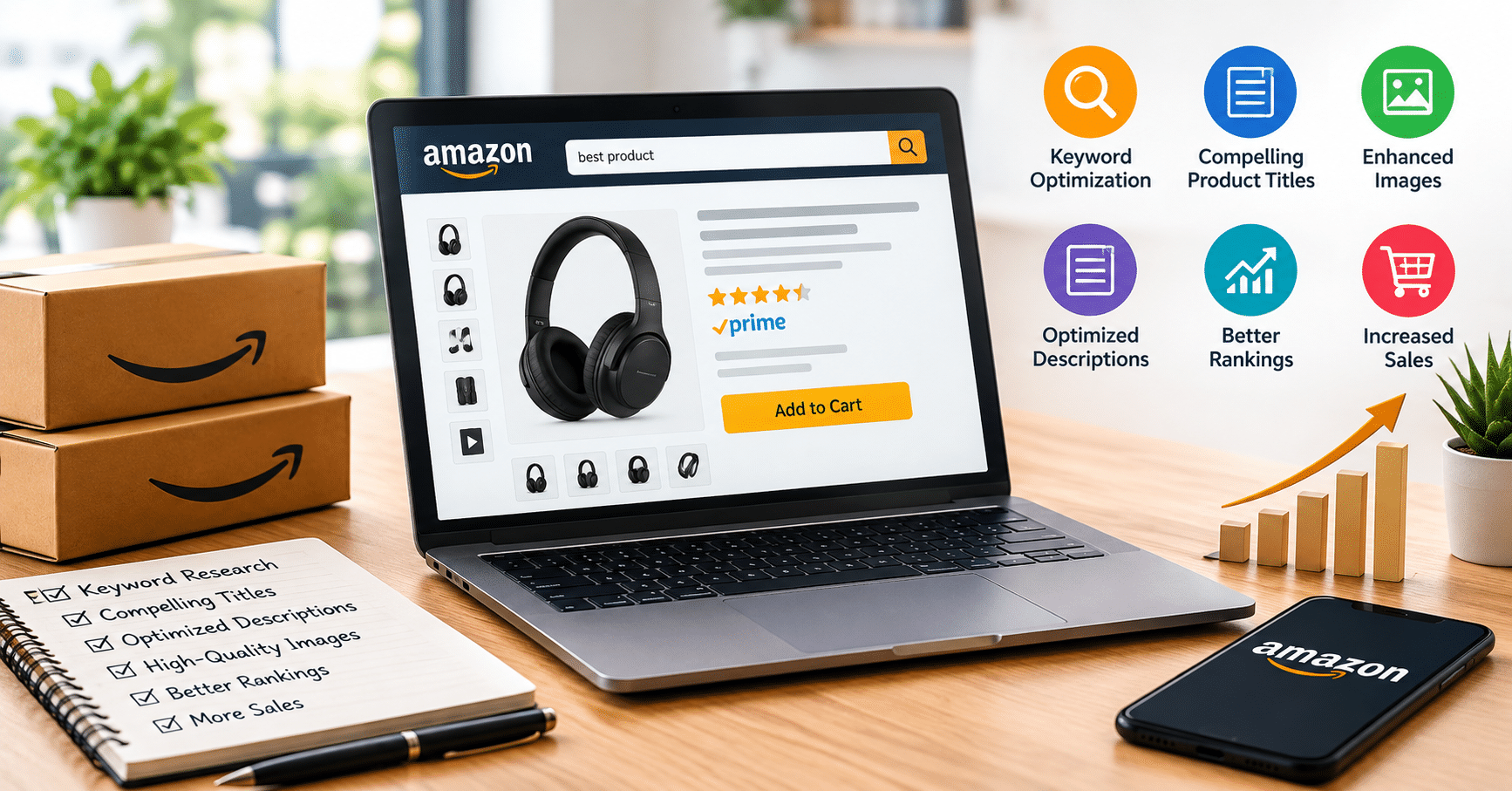
Selling on Amazon is highly competitive. Even when you have a quality product, customers may never discover it if your product listing is poorly structured, difficult to understand, or missing important information.
Professional Amazon listing optimization services can help sellers improve the quality, clarity, search relevance, and customer experience of their product detail pages.
A well-optimized Amazon listing should do more than include keywords. It should clearly communicate what the product is, explain its important features, use accurate images, answer customer questions, and make it easier for shoppers to decide whether the product is right for them.
At jayantadigitalpro.com, we provide Amazon listing optimization services designed to help sellers improve their product pages with a strategic combination of keyword research, listing content optimization, product page improvements, and conversion-focused recommendations.
Whether you are launching a new product or trying to improve an existing Amazon listing, thoughtful optimization can create a stronger foundation for your Amazon marketing strategy.
What Are Amazon Listing Optimization Services?
Amazon listing optimization services involve improving the different components of an Amazon product detail page so that the listing is clearer, more relevant, customer-friendly, and commercially effective.
Depending on the product and seller’s goals, optimization may include:
- Amazon keyword research
- Product title optimization
- Bullet point optimization
- Product description optimization
- Product image recommendations
- Backend search-term research
- A+ Content strategy
- Competitor listing analysis
- Search-intent analysis
- Product page structure
- Conversion-focused content
- Listing performance review
- Content testing recommendations
Amazon’s own seller guidance identifies product titles, bullet points, images, product details, descriptions, and customer-friendly search terms as important components of creating and optimizing product listings.
The exact optimization strategy should depend on the product category, audience, competition, available product information, and Amazon’s applicable requirements.
Why Amazon Listing Optimization Matters
An Amazon product page has two important jobs.
First, it needs to help shoppers discover and understand the product.
Second, it needs to help interested shoppers evaluate the product and decide whether to purchase.
A listing that is difficult to understand can create unnecessary friction.
For example, customers may leave a product page when:
- The title does not clearly explain the product
- Images do not show important features
- Bullet points are vague
- Product specifications are missing
- The description does not answer common questions
- The content contains confusing claims
- The page does not communicate the product’s practical benefits
- The listing is difficult to understand on mobile devices
Professional Amazon listing optimization services can address these areas while keeping the customer’s needs at the center of the content.
Amazon Keyword Research
Keyword research is an important part of Amazon listing optimization.
Customers use search terms to find products, but different shoppers can describe the same product in different ways.
For example, someone searching for a travel accessory might use phrases such as:
- travel organizer
- luggage organizer
- packing organizer
- travel storage bag
- suitcase organizer
The appropriate keywords depend on the actual product and the language customers use when searching for it.
Amazon recommends using customer-friendly search terms in product listings and notes that keywords can be incorporated into titles, descriptions, bullet points, and other listing areas.
Effective keyword research should consider:
- Product relevance
- Customer search intent
- Product features
- Product benefits
- Category terminology
- Common variations
- Long-tail searches
- Competitor positioning
- Seasonal search behavior where relevant
The goal is not to insert every possible keyword. The goal is to identify relevant terms that accurately describe the product.
Amazon Product Title Optimization
The product title is one of the first pieces of information shoppers see.
A strong title should make the product easy to identify and provide useful information without becoming confusing or unnecessarily repetitive.
Depending on the category and applicable Amazon requirements, a title may communicate information such as:
- Brand
- Product type
- Model
- Key feature
- Size
- Color
- Quantity
- Important differentiator
For example, instead of writing an overly repetitive title such as:
“Wireless Headphones Bluetooth Headphones Wireless Headset Bluetooth Headset”
a more useful title could communicate the product’s important attributes in a natural way.
Amazon’s current listing guidance emphasizes clear product information and customer-friendly listing content.
Title optimization should also follow the latest category-specific Amazon requirements rather than relying on a universal formula.
Amazon Bullet Point Optimization
Bullet points provide an opportunity to communicate important product information quickly.
Customers often scan product pages before deciding whether to read more.
Effective bullets can highlight:
- Key features
- Product benefits
- Materials
- Dimensions
- Compatibility
- Usage information
- Included accessories
- Important specifications
- Care instructions
Amazon’s current guidance recommends using bullet points to highlight important details, and its Amazon SEO guidance specifically discusses balancing useful detail, keywords, and customer experience.
Good bullet points should answer practical customer questions instead of simply repeating the product title.
Amazon Product Description Optimization
The product description provides additional space to explain the product in greater detail.
A useful description can explain:
- What the product does
- How it works
- Who it is designed for
- Important features
- Practical benefits
- Materials
- Dimensions
- Usage instructions
- Care information
- Compatibility
Descriptions should be accurate and consistent with the actual product.
Avoid unsupported claims or exaggerated statements that could create customer confusion or compliance problems.
The purpose of the description is to help the customer make an informed decision.
Amazon Product Image Optimization
Images play an essential role in eCommerce because shoppers cannot physically examine a product before purchasing.
Amazon’s current listing guidance emphasizes accurate and illustrative product images and recommends sharp, clear product photography.
A strong image strategy may include:
- Clear primary product photography
- Multiple product angles
- Lifestyle images where appropriate
- Feature-focused images
- Size or dimension visuals
- Product-in-use images
- Detail shots
- Packaging or included-item visuals when relevant
Images should accurately represent the product.
Avoid adding visual information that could mislead shoppers about what is included with the purchase.
Amazon Backend Search Terms
Backend search terms can provide another way to communicate relevant search information to Amazon.
The exact requirements and available fields can change, so sellers should use current Amazon guidance when entering search terms.
A thoughtful backend keyword strategy may consider relevant terms that:
- Describe the product
- Reflect customer terminology
- Include useful variations
- Support relevant search intent
- Are not already unnecessarily repeated
The objective should be relevance rather than filling fields with unrelated keywords.
Amazon A+ Content Optimization
A+ Content can give eligible sellers additional opportunities to enhance product detail pages with richer visual and informational content.
Amazon describes A+ Content as a tool for adding enhanced images, customized text placements, videos, comparison charts, and other content to product pages.
A+ Content can be useful for:
- Explaining product benefits
- Demonstrating product features
- Communicating brand identity
- Comparing products
- Answering customer questions
- Providing additional visual information
- Creating a consistent brand experience
Amazon currently reports that Basic A+ Content can increase sales by up to 8% and well-implemented Premium A+ Content by up to 20%, based on Amazon’s internal data. These figures are not guarantees for an individual product or seller.
Good A+ Content should add useful information rather than simply repeat the main listing.
Amazon Brand Story and Brand Presentation
For eligible brands, brand-focused content can help create a more consistent experience across product pages.
Brand storytelling can communicate:
- Company background
- Brand values
- Product philosophy
- Product range
- Customer-focused information
The messaging should remain relevant to the shopper and product.
The purpose is to strengthen understanding and trust rather than distract customers from the product they are considering.
Competitor Listing Analysis
Competitor research can reveal how other sellers present similar products.
An effective analysis may examine:
- Product titles
- Bullet points
- Images
- Product descriptions
- A+ Content
- Customer questions
- Review themes
- Product features
- Pricing context
- Common customer concerns
However, competitor analysis should not mean copying another seller’s content.
Your listing should communicate your own product accurately and provide original value.
Customer Review Analysis
Customer reviews can provide useful insights into what buyers actually care about.
Positive reviews may reveal:
- Popular features
- Frequently appreciated benefits
- Common use cases
- Product strengths
Negative reviews can reveal:
- Confusing information
- Missing specifications
- Product expectations
- Common concerns
- Frequently misunderstood features
Review analysis can therefore help identify questions that the listing should answer more clearly.
The goal is not to manipulate reviews. It is to use customer feedback to improve product communication.
Amazon Customer Questions
Questions from shoppers can reveal information gaps.
If customers repeatedly ask about:
- Size
- Compatibility
- Materials
- Installation
- Battery life
- Included accessories
- Usage
- Maintenance
then the listing may benefit from clearer information about those topics, provided the information is accurate.
A customer-focused listing anticipates reasonable questions before shoppers need to ask them.
Amazon Conversion Optimization
Search visibility is only one part of Amazon selling.
Once shoppers reach a product page, the listing needs to help them evaluate the product.
Conversion-focused optimization can involve improving:
- Product images
- Titles
- Bullet points
- Descriptions
- A+ Content
- Product information
- Feature explanations
- Customer objections
- Trust-building information
Amazon provides Manage Your Experiments for eligible sellers to test different versions of product titles, images, bullet points, descriptions, and A+ Content.
Testing can be more useful than making assumptions about which version customers will prefer.
Mobile-Friendly Amazon Listings
Many customers browse and shop using mobile devices.
This means listing content should remain understandable when viewed on smaller screens.
Consider:
- Clear titles
- Scannable bullet points
- Strong product images
- Concise descriptions
- Easy-to-understand product information
- Visual A+ Content
- Logical content hierarchy
The goal is to make important information accessible without unnecessary complexity.
Amazon Listing Optimization for New Products
Launching a new product creates an opportunity to build a strong listing from the beginning.
Before launch, sellers can prepare:
- Relevant keyword research
- Product title
- Bullet points
- Product description
- Image strategy
- A+ Content
- Product specifications
- Search-term strategy
- Customer-focused messaging
A well-planned listing can provide a stronger foundation than trying to correct poorly structured content after launch.
Amazon Listing Optimization for Existing Products
Existing listings can also benefit from optimization.
A listing review may identify:
- Weak keyword targeting
- Unclear titles
- Poor bullet points
- Missing product information
- Weak imagery
- Outdated descriptions
- Customer objections
- Poor content structure
- Opportunities for A+ Content
- Areas for testing
Optimization should be based on the actual product, customer behavior, and available performance information.
Common Amazon Listing Optimization Mistakes
Keyword Stuffing
Repeating keywords excessively can make listing content difficult to read. On your own website, excessive repetition can also create SEO problems because Google identifies unnatural keyword repetition as keyword stuffing.
Copying Competitor Listings
Competitor research can be useful, but copying another seller’s content does not create a unique value proposition.
Writing Only for Algorithms
Amazon listings ultimately need to communicate with real shoppers.
Using Vague Bullet Points
Bullets should provide useful product information rather than generic promotional language.
Using Poor Images
Low-quality or incomplete product photography can make it harder for customers to understand what they are purchasing.
Making Unsupported Claims
Claims should be accurate, supportable, and appropriate for the product category.
Ignoring Customer Questions
Repeated questions can reveal information that should be easier to find in the listing.
Failing to Test
When testing tools are available, sellers can use controlled experiments rather than relying entirely on assumptions. Amazon’s Manage Your Experiments tool supports testing of several listing elements.
Our Amazon Listing Optimization Services Process
At jayantadigitalpro.com, we can use a structured approach to Amazon listing optimization.
Step 1: Product and Market Review
We first examine the product, target customer, category, features, benefits, and competitive environment.
Step 2: Keyword Research
Relevant customer search terms are identified and organized according to search intent and product relevance.
Step 3: Listing Content Review
The existing title, bullets, description, images, and other available content are evaluated.
Step 4: Competitor Analysis
Relevant competing listings are reviewed to identify common customer expectations and opportunities for differentiation.
Step 5: Content Optimization
Listing components are improved with a focus on clarity, relevance, customer experience, and conversion opportunities.
Step 6: A+ Content Strategy
Where eligible and appropriate, recommendations can be developed for richer product-page content.
Step 7: Quality and Compliance Review
Content is reviewed for accuracy, consistency, readability, and applicable marketplace requirements.
Step 8: Performance Monitoring
Where data and testing tools are available, performance can be monitored and content can be refined based on evidence.
Why Choose jayantadigitalpro.com?
At jayantadigitalpro.com, our approach to Amazon listing optimization services focuses on more than inserting keywords into product pages.
We aim to help sellers communicate their products more effectively through:
- Amazon keyword research
- Product title optimization
- Bullet point optimization
- Product description optimization
- Product image recommendations
- Competitor listing analysis
- Customer-focused content
- A+ Content strategy
- Conversion-focused improvements
- Listing content reviews
Every product is different. The right optimization strategy should reflect the product category, target audience, competitive environment, and seller’s business objectives.
If your Amazon listing needs clearer messaging, stronger keyword targeting, better product communication, or a more customer-focused structure, jayantadigitalpro.com can help.
Frequently Asked Questions About Amazon Listing Optimization Services
What are Amazon listing optimization services?
Amazon listing optimization services involve improving product titles, bullet points, descriptions, images, keywords, A+ Content, and other listing elements to create a more relevant and customer-friendly product page.
Why is Amazon listing optimization important?
A well-structured listing can help shoppers understand the product, find important information, evaluate its features, and make a more informed purchasing decision.
Does Amazon listing optimization include keyword research?
Yes. Keyword research can be an important part of listing optimization. Relevant search terms should be selected based on the actual product and customer search behavior.
Can Amazon listing optimization increase sales?
Optimization can improve the quality and customer experience of a product listing, but sales depend on many factors, including product demand, pricing, reviews, competition, availability, advertising, and customer experience. No optimization service can guarantee a particular sales result.
Do you optimize Amazon product titles?
Yes. Product title optimization can focus on clarity, relevant product information, customer search intent, readability, and applicable Amazon requirements.
Do you provide Amazon bullet point optimization?
Yes. Bullet points can be improved to communicate important features, benefits, specifications, and customer-focused information more effectively.
Can you optimize Amazon A+ Content?
A+ Content strategy and optimization can be included where the seller and product are eligible. Amazon provides Basic and Premium A+ Content options with different capabilities.
Do you provide optimization for existing Amazon listings?
Yes. Existing listings can be reviewed to identify opportunities for improving content, keywords, images, customer communication, and conversion-focused elements.
How much do Amazon listing optimization services cost?
Pricing depends on factors such as the number of products, listing complexity, research requirements, content scope, A+ Content requirements, and the level of optimization needed.
Contact jayantadigitalpro.com for pricing based on your specific Amazon listing requirements.
Final Thoughts
Amazon competition makes product presentation increasingly important.
A strong product listing should communicate the product clearly, use relevant search terminology, answer customer questions, present accurate information, and provide useful visuals.
Professional Amazon listing optimization services can help sellers improve these areas through keyword research, title optimization, bullet point writing, product descriptions, image recommendations, A+ Content strategy, competitor analysis, and conversion-focused improvements.
Amazon itself recommends customer-friendly search terms, accurate product information, strong images, and enhanced content as part of creating compelling product listings.
At jayantadigitalpro.com, we focus on creating Amazon listing content that is useful, relevant, clear, and aligned with your product and target customer.
Contact jayantadigitalpro.com for pricing and discuss your Amazon listing optimization project today.